Strength, Health, Physical Development, Inspiration, and Know-How


Orville and Wilbur Wright of Dayton, Ohio formed the Wright Cycle Company in 1892 to sell bicycles. Soon afterwards, the Wright Brothers expanded their business by adding a repair shop and later by manufacturing their own brand of bicycles. The repair and manufacturing of bicycles gave the brothers a wide range of mechanical and engineering skills that would later enable them to discover the laws of flight and to build the world’s first flying machine. The immense success the Wright Brothers enjoyed, in large part, resulted from their relentless drive to stay focused on their goals until they were achieved. Public domain photograph.
Perhaps more so than any other factor, success in a chosen endeavor requires a relentless drive to make things happen. Raw ability certainly counts, but more often than not it is drive rather than inherent capability that carries men and women to greatness.
This is not to say that everybody is on an equal playing field. We all know that some individuals have natural advantages, inherited gifts which give them a head start in life. However, no matter how much natural talent a person may possess, if their talent is not fostered with a burning drive to succeed nothing special is likely to happen.
“Drive”, as I use the word in this post, means something much more than just desire. When a person has internal drive, there exists within her a force so powerful that it brings forth an immediate urge to action, regardless of whatever obstacles may lie along the path to success. Drive does this by dissipating the evils of possibility thinking, allowing progress to spring upwards uncontested in nearly any terrain.
Sometimes, no matter how much effort is put forth, things don’t go as originally hoped for or as planned. But, almost always, the person with internal drive finds triumph in one form or another. Such triumph may be in direct line with the original goal, or it may manifest itself as a blessing in disguise. Consider these examples: Walt Disney went on to become one of the greatest movie makers of all time after he was fired as a newspaper artist for his “lack of creativity.” Albert Einstein went on to develop his Special Theory of Relativity after he was refused admittance to the Zurich Polytechnic School. And, Orville and Wilbur Wright developed the principles of flight after they opened a bicycle shop in Dayton, Ohio.
Without doubt, Walt Disney, Albert Einstein, and the Wright Brothers possessed natural talents. However, as with all great achievers, these men did not find success through their talents alone. Rather, it was their relentless drive, one backed with an iron will and decorated with nerve and grit, which propelled them forward. And when, at first, success didn’t come as desired, none of these ambitious men gave in to their failures. Instead, they learned from their setbacks, made adjustments to their course of action, and created new opportunities.
People whose actions are guided by chance, accident, or tradition rarely develop the internal drive needed to achieve greatness in anything. A guiding drive almost always shows itself only after you discover what you really want to achieve in life and after you make a decision to become an architect of your own fate. Only then will you be able to bring forth your full capability, overcome shortcomings, and achieve the highest level of personal satisfaction. This is true in the world of strength, and this is true in any other field of interest.
Thanks for visiting,
Rob
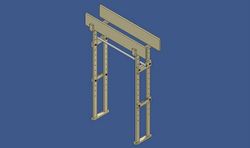
The original Harvey Maxime Bar proved to be too expensive for practical use. This drawing shows a modified and more affordable “pipe-based” version of the apparatus. Like the original version, it allows the user to “lock” the lifting bar at a desired height before use. Drawing and conceptual design by Robert Drucker.
During the late 1940s, Harvey Roosevelt developed a unique apparatus that would allow a lifter to perform a variety of heavy barbell exercises in complete safety and without need for a spotter. This device, which became known as the Harvey Maxime Bar, was a precursor to the power rack. And with its advent, many new doors to gaining strength and might were opened.
A few years after its introduction, Charles A. Smith, arguably the most prolific strength writer in the history of physical culture, gave much praise to the Harvey Maxime Bar. In one of his MANY outstanding articles, Smith wrote the following about Roosevelt’s apparatus:
“Few people realized the enormous potentials it contained … they are simply immense and I personally regard the Harvey Maxime Bar as one of the greatest advances ever made in the Science of Weight Training. The terrific scope of this apparatus will one day be marked as historic. It is a great pity that the originator never was given the acclaim that was justly and rightfully his, and Weider Publications is PROUD to do so via the medium of this article.”
The Harvey Maxime Bar, as developed by Roosevelt Harvey, consisted of two solid support bars, each which stood upright and was welded to a steel base plate at the floor end. On each of the two bases, weight plates could be fitted at each end to provide a desired resistance. A cross bar, which functioned as a “lifting” bar, could be moved along the two vertical support bars. And, once the cross bar was brought to a desired height, it could be locked in place. The lifter would then use the cross bar like a barbell, lifting the entire apparatus, along with its weight load, off of the ground. After completion of an exercise, the apparatus was then lowered back to the floor in complete safety.
The main objection to the original Harvey Maxime Bar was its cost of construction. As such, Charles Smith presented a modified design of Harvey’s apparatus, one which could be constructed on a budget by using chains, shackles, collars, and a regular barbell. In 13-Secret Exercises of Physique Champions, author Dennis B. Weis details the construction of the “Chain Modified” Harvey-Maxime Bar apparatus, and he also provides much history about the device. Dennis’ e-Report is both interesting and informative, and it is available for free as a PDF file on the internet. Just do a Google search and you should have no problem finding it.
As an alternative to the “Chain Modified” Harvey Maxime Bar, a pipe-based construction can be considered as a feasible and affordable option. One idea based on this approach is illustrated by the conceptual drawing shown above. In this presented design, four vertical supports are made from schedule 40 3/4-inch nominal pipe (1.05 inch actual outer diameter); the cross-bar is made from schedule 40 1-inch nominal pipe (1.315 inch actual outer diameter) or from a 3/4-inch solid steel bar; the four weight-holding uprights are made from 3/4-inch nominal schedule 40 pipe; and each of the two bases is made from four-by-four lumber (actual size 3.5 inches by 3.5 inches). Two grade eight 5/16-inch-diameter bolts are used to secure the cross bar to the four support pipes, and each of the four weight-holding uprights is held in place with a 5/16-inch-diameter bolt passed through its base. Holes in each of the four vertical supports are spaced two inches apart.
Later this year, I plan to build a pipe-based Harvey Maxime Bar similar to the one illustrated here. The action will be captured as part of the Home Gym Overhaul Series. I’ll also provide material cost details, step-by-step building instructions, and a few alternative building options to consider. Down the road, we’ll also look at how the Harvey Maxime Bar can be used to build enormous strength and power. And when we do, it will be crystal clear why Charles A. Smith, referring to this remarkable apparatus, stated that, “No gymnasium should be without it.”
Thanks for visiting,
Rob
Edwin C. Barnes (left) and Thomas Edison look over an Ediphone outside Edison’s West Orange laboratory complex in New Jersey. Public domain photograph.
Over a hundred years ago, a young man from the Midwest had a dream to become a partner of the greatest inventor on Earth, Thomas A. Edison. So strong was his desire to form this partnership, Barnes made up his mind that he would relentlessly pursue his goal of becoming a business associate of the famed inventor until he met success. There would be no retreat, and nothing was going to stop him from reaching his goal, the young man pledged to himself.
Barnes could not afford to purchase a train ticket for passenger fare, and he had no special technical skills. Furthermore, he had only meager clothes to wear. But, these obstacles could not stop this determined man from visiting Edison’s famous laboratory in West Orange, New Jersey and pursuing his dream.
On a fateful day in 1905, and driven by a desire which transcended poverty and a lack of know-how, Barnes rolled into West Orange on a freight train. He then, poorly dressed and looking more like an outcast than a man of achievement, walked into the famous Edison Laboratory and told the great inventor that he had come to form a partnership with him. Nearby members of Edison’s staff were amused by the boldness of the poor-looking man, and they laughed at him hysterically. But, Edison did not laugh. For, what he saw was a determined young man who was prepared to do whatever it would take to help bring new growth to his company.
Impressed with Barnes’ ambition and internal drive, Edison decided to give the poor man a chance of realizing his dream — not as a partner, but rather as a floor sweeper. Barnes wisely accepted Edison’s offer, not dejected in the slightest by the job the famous inventor had in mind for him. For, Barnes understood that he was given a chance of a lifetime to show Edison what he could do for him. And, he knew that accepting the humbling position would open the door for him to observe how the brilliant Edison thought. The wise fellow also understood that Edison was offering him a tremendous opportunity to meet his friends and associates, some of the most influential and powerful people in the world.
Thomas Edison sharing a funny story with Edwin C. Barnes (center) and Nelson Durand (right). Circa 1912. Public domain photograph.
Starting with a broom in his hands, Edwin C. Barnes did the best work he possibly could for Edison, and he never once backed down from his goal of establishing a partnership with the world’s leader of practical technology. Months went by, and to the unobserved nothing special seemed to happen. But, Barnes was learning what made Edison tick, and he was setting the stage to attract opportunities his way.
After working for Edison for nearly two years, Barnes “saw” a golden opportunity, and he seized it with full force. Following many years of work, the inventor was ready to commercialize the Edison Dictating Machine, a recorder specifically designed to capture the human voice. Edison’s machine, later renamed the Ediphone, recorded “voice letters” on a wax cylinder, and its inventor thought very highly of it. However, when members of Edison’s sales force looked at what his machine could do, most of them very much doubted that the invention would prove successful commercially, and they expressed little interest in trying to sell it.
Barnes, in contrast, recognized that Edison’s dictation machine could help thousands of executives across the country by allowing them to dictate at any time, day or night, for later playback. No longer would the executive need to have at his side a stenographer to record his thoughts, Edison’s enthusiastic employee envisioned. Barnes also realized that the dictation machine could help business executives save time, accomplish more, and increase profits as a result.
After working out a marketing plan, Barnes approached Edison and urged him to let him sell his dictation machine. Edison, impressed with his employee’s relentless desire to sell the new machine and his thoroughness of preparation for doing so, readily agreed to his proposition. And, within months Barnes had sold thousands of Edison dictating machines and gained a lucrative contract to market and distribute the recording device across America.
So successful was Barnes at selling Edison’s dictating machine, he became a multimillionaire at a relatively young age. But, more importantly, Barnes became a man who helped thousands of people across the country benefit from Edison’s device. And, it is probable that the true potential of Edison’s machine would not have been realized had it not been for the uncanny insight that Barnes fostered during his working years at the famous laboratory complex in West Orange.
Most likely, there were many factors, both tangible and intangible, that transcended Edwin C. Barnes from a young man with little money and a rather lame portfolio to one of the most capable and accomplished salespersons Thomas Edison ever knew. However, the remarkable success that Barnes brought to himself can be attributed largely to seven key traits that he consistently exibihited with full force. They are:
An ad for an Edison Dictating Machine, circa 1917. Public domain photograph.
Barnes also saved much of his initial earnings as an employee of Edison’s West Orange laboratory complex to buy new and quality clothes. And, eventually, he built a rather impressive wardrobe. Referring to a time just before Barnes made it big within the Edison organization, Napoleon Hill wrote in the Law of Success:
“In those days he had the largest and most expensive collection of clothes I had ever seen or heard of one man owning. His wardrobe consisted of thirty-one suits; one for each day of the month. He never wore the same suit two days in succession.”
And, when Napoleon Hill asked the upcoming salesman why it was that he paid special attention to his attire, Barnes replied, “I do not wear thirty-one suits of clothes entirely for the impression they make on other people; I do it mostly for the impression they have on me.”
Edwin C. Barnes did not judge his success by how much money he made or by how many sales he generated. He considered personal gain and sales numbers just a by-product of his true aim — to achieve 100% customer satisfaction! As such, Edison’s “partner” did not resort to sales gimmicks or trickery. In fact, he would not urge a sale of a dictating machine without first verifying that the potential customer could greatly benefit from it. And, once Barnes did sell a dictation machine to a qualifying customer, this was just the beginning. He followed up with service, making sure that the buyer was satisfied with the performance of the product and fixing any noted problems without hassle and without excessive delay.
So important was his commitment to his customers, Barnes considered his devotion to providing excellent service to be the single biggest influence on his success as a salesperson. For, he understood that without customer satisfaction true success cannot be realized, no matter how much fame or fortune is obtained.
Thanks for visiting,
Rob
One of the most powerful demonstrations of finger strength I have ever seen: Robert L. Jones of Pine Bluff, Arkansas doing a truly mind-blowing stunt, circa 1927. Public Domain Photograph.
Over the years, I have experimented with many ways to build a stronger grip: hand crushers, thick-bar training, pinch-gripping, and wrist rolling to name a few. However, the biggest advance I have made in my hand and forearm strength has come within the last two months of my 30-year training career thanks to a single exercise: the finger-tip pushup. And, I must give Paul Wade full credit for introducing me to this superb exercise via his excellent book, Convict Conditioning 2.
I have found the finger-tip pushup to be second to none as a hand, wrist, and forearm builder. Since introducing this exercise into my training routine, my forearms are noticeably more muscular, and my grip strength has magnified immensely. I just can’t explain in words the power this exercise builds; the finger-tip pushup is an exercise you must try for yourself to fully appreciate and understand.
During my workout tonight, I performed the finger-tip pushup with my feet elevated approximately 36 inches (just shy of a meter) above the horizontal plane. Elevating my feet in this fashion directed a greater proportion of my body weight on my fingers and arms, and the force upon them was utterly TREMENDOUS. It took white-hot concentration to keep my fingers from buckling under the load, and if I hadn’t kept my forearms fully contracted at ALL times as I performed the movement, I think my fingers would have snapped!
It is a goal of mine to keep increasing the elevation of my legs until I can do full hand-stand pushups on my finger tips. I am sure that this goal is beyond my strength level at the current time, but I get inspiration from Robert L. Jones, an oldtime hand-balancing master. Check out the photo of him above performing a truly amazing strength stunt. I doubt that more than one person out of a million can duplicate this difficult move. What incredible finger and arm strength Robert Jones had.
By the way, if you are the person out of a million who can perform a strength stunt similar to the one demonstrated by Robert Jones above, send me a photo of yourself doing it, and I’ll be glad to post it right here on MOI and give you the recognition you deserve.
Now, I’m going to turn things over to MOI contributor Peter Yates. Like myself, Peter has been experimenting with some of the methods taught by Paul Wade in Convict Conditioning 2 with great success. Printed with his permission, below is an email that Peter sent me a few days ago that explains what he has been doing and how it is working for him.
Thanks for visiting,
Rob
I recently purchased CC2, and I immediately started to do the Trifecta. It is a very clever combination, and I could feel positive results quite quickly. I am also excited about working with the Flag.
Even though I have done a lot of body weight training over the years, including those in CC1, I still began at the very easiest level. My reason being that I knew that I had weaknesses in certain moves, even though I could do them at a more advanced level. And, by going back to the start, I could work on those weaknesses, something that the progressions make easy to do. I really appreciate the progressions, and my aim is to own each level thoroughly before moving on.
I also believe that my old injuries will benefit from the progressions. They are certainly paying off, and I would recommend them to anyone regardless of current ability.
Although I train with weights 2x a week and do the body weight training 1x a week, I do the Trifecta daily and some light body weight on days following the weights as active recovery. This also helps me with the skill component.
It is amusing to me to find that there are so many people wasting precious time debating weather Paul Wade really exists, if he even was in prison, or if John Ducane and Pavel wrote the books under his name. The only thing that matters is that the content is really sound and that the methods work. Whoever put it together did a great job, and it is also a fun read. I may not agree with him on everything, but I do on quite a bit. And, I respect his opinion on everything. CC works for me anyway.
Regards,
Peter
This is the apparatus that was “featured” in my muscle-building dream last night. The four upright two-by-fours are lap jointed with the side base boards for extra strength. In addition, the calf board is bolted to the unit at a desired position, and it can be removed when not needed. Drawing and copyright by Robert Drucker.
Although I regularly have vivid and detailed dreams, I don’t ordinarily dream about about muscle building. But, last night things were a bit different than usual. A few hours after drifting off into a deep sleep, I found myself in an unknown gym training my calves hard and heavy with a rather interesting power-building apparatus. This apparatus allowed for placement of a barbell at any desired position like a power rack, but the barbell was sandwiched between two pairs of two-by-fours. In addition, a small-diameter pipe (quarter inch nominal) was secured to the barbell-end of each two-by-four with metal clips. The muscle-building apparatus was also wood screwed securely to a thick plywood base. This design utilizes the weight of the lifter to keep the apparatus from moving as the barbell is pushed upwards.
The two-by-four pipes, which were lightly oiled on the outside to minimize friction, served to “guide” the barbell by allowing up and down movement only. This arrangement proved invaluable for calf training, and I did three different exercises for this muscle group. First, I performed calf raises on a mounted calf board while holding the barbell with my hands. This exercise not only gave my calves a tremendous beating, it torched my forearms and grip to the limit. It even had my back muscles pleading for mercy.
Second for my lower legs, I performed traditional calf raises with the guided barbell resting across my shoulders. I found this movement to be a VERY effective muscle builder because the force of the barbell was 100% direct on the calves, and the resistance was 100% steady. Most commercial calf machines, in contrast, do not provide a direct and steady force because the angle of pull varies throughout the range of motion.
My third movement for the lower legs was the seated calf raise. I did this movement by adjusting the barbell height, sitting on a bench, placing a padded board across my knees, getting my knees and the padded board underneath the barbell, lifting up the barbell from the bolted support boards by raising my toes on an attached calf board, and then removing the barbell support boards so that a full range of motion could be achieved. And, at the termination of a set, I would push up the barbell with my toes just a bit and replace the support boards before lowering and securing the barbell. This procedure worked great, and the seated calf raise done on this special apparatus gave further growth encouragement to my aching calves. So much for the idea that a bodybuilder needs both a seated calf machine and a standing calf machine; the “dream” machine can do it all!
With my calves on fire during my unconscious adventure, I awakened after my second set of seated calf raises. And upon awakening, I rushed to draw what the “dream” machine looked like before it vanished from my memory.
Now, looking at my drawing a day later, I can see plenty of room for improvement, and many details must be added before I can say that the design is complete. Nonetheless, the “dream” machine seems like it would be a great piece of equipment to have in a home gym. It would be relatively inexpensive to build, and it would offer a lot of bang for the buck. In addition to calf raises of all sorts, this nifty unit could be used to perform leg presses, press lockouts, pullups and chin-ups, hanging leg raises, quarter squats, and many other muscle-building exercises.
Thanks for visiting,
Rob
P.S. Operation Home Gym Overhaul is still in the works, although it has been postponed until this Spring. This upcoming series is going to be awesome, and it will feature DETAILED equipment-building instruction.
Studying and listening to great works by Wolfgang Amadeus Mozart and other famous musical composers brought forth a better understanding of body-building. Public domain image.
There is nothing wrong with wanting bigger muscles. But, if the acquisition of more muscle mass is all that you seek from a bodybuilding program, you will likely find nothing but disappointment from your training.
The reason for this is that muscles in and of themselves do not enhance a person’s psyche and intellect. Nor does the sole build-up of muscle tissue charge the human spirit with fulfillment and a sense of mastery. In short, going from A to B provides a person with little if the journey along the way fails to stimulate the mind, establish discipline, and provide a rewarding endeavor in and of itself.
It is only within the context of intellectual achievement that the true power of bodybuilding can be realized and understood. And, those who view strength training as nothing more than physical promotion cannot see nor realize the vastness of efficacy that a more complete approach to muscle building can provide.
However, strength athletes who approach bodybuilding as a life journey filled with opportunities to learn, to set and conquer goals, to problem solve, and to enjoy the process will obtain much more than just bigger muscles. They will procure many new skills and a heightened self-esteem, acquisitions which will last long after their acquired big muscles inevitably fade away with older age.
Perhaps you have noticed that on Muscles of Iron we do not solely publish “muscle-building” articles. And, it may appear that some of the articles and posts have nothing to do with strength training. However, if you are willing to take a deeper look, you will likely see that nearly all of the writings on this site serve to promote bodybuilding at a level of greater reverence than a mere emphasis on physical training could possibly achieve. That is, we aim to bring the world of physical culture something much more meaningful than just another repeat of how some star athlete built his huge arms or his massive chest.
I am a firm believer that to benefit the most from a bodybuilding program – in all contexts, not just in terms of muscle growth – the student of strength must expose him or herself to a variety of ideas, both within the world of physical culture and outside of it. Exposure to new ideas brings forth a higher understanding of phenomenon, a greater sense of pleasure, a heightened sense of awareness, and a more exciting life. In fact, to get the most from anything, you must first understand it. And, often times when we don’t like or benefit from something, it is because we don’t understand it.
Some years ago, I hated opera and I thought that rock ‘n roll was the only form of music that mattered. But, one day I had a lengthy discussion with a musician whom I highly respect, and he told me that I would probably enjoy listening to a chosen opera if only I would take the time to learn something about it through books, librettos, and other means. I vividly remember him telling me, “No appreciation of an opera can be complete if the story is unclear to the listener.”
My “teacher” also taught me that the more I learned about an opera in relationship to other forms of culture (including the life and times of the composer), the more benefit and fulfillment I would derive from listening to it. And, he was absolutely right. With just a little bit of self-study, I soon acquired a taste for opera and for other forms of music outside of the rock ‘n roll genre. In fact, as I am writing this post, playing on my turntable is The Barber of Seville, a terrific opera which was composed by Gioacchino Antonio Rossini.
Now, I hope that I did not bore you with my diversion to music. My point is that bodybuilding is much like an opera: You must understand it before you can derive the most pleasure and benefit from it. And, like an opera, the more you integrate bodybuilding with its culture and history, the more meaning and fulfillment it will bring to your life. Thus, the true power of bodybuilding can be unleashed only when something much greater in magnitude is sought than just larger muscles.
Thanks for visiting,
Rob
Gilbert Hunt, shown here in his old age, was a man of “Herculean” strength who possessed a heart of gold. Public domain image.
In A Bicentennial Tribute, a recent article I wrote about the catastrophic fire at the Richmond Theatre in 1811, one of the heroes of the story was Gilbert Hunt. In this post, more tribute is given to this hero, for he was truly a remarkable man.
Gilbert Hunt was born a slave in King William County, Virginia around 1780. But, despite not having freedom for many years, he built a solid reputation among those who knew him through honesty, courage, hard work, and a willingness to help people in need.
As a young man, Gilbert was said to have been almost a Hercules, for he possessed a huge frame and a powerful set of muscles. Mr. Hunt attributed his extraordinary strength to his industrious work as a blacksmith. For hours a day during his working life, the ring of Gilbert’s anvil could be heard outside of his shop as he swung his heavy hammer to mend metal.
Gilbert grew up in the Piping Tree, a cavern that was located along the Parmunkey River and which was owned by his master. At this tavern, the young slave helped to run the business, and it was here that he first established his commitment to hard and productive work.
Gilbert continued to live and work at Piping Tree until his master’s youngest daughter got married. At this time, the lad was sent to Richmond to work under the newlywed’s husband, from whom he learned the carriage-making trade. After working four or five years under him, however, Gilbert’s new master died, and he was sold for a second and last time.
On December 26, 1811, not long after Gilbert was acquired by his final purchaser, a horrific fire broke out at the nearby Richmond Theatre during a record-crowd performance. As detailed in A Bicentennial Tribute, Hunt rushed from his blacksmith shop to the burning scene, and through his courage and with his stupendous strength he helped to save many lives.
When the War of 1812 broke out, Gilbert was put to work in his master’s shop as a blacksmith for the U.S. Army. And, fully determined to defend his country from enemy attack, he worked several hours a day for 18 straight months preparing guns and cannons for defense. Recalling later in life his service work for the Army, the strongman recorded in his writings,
“I ironed off carriages for the cannon, mounting one every two days. We then had four forges going constantly. I was also busily engaged in making pick axes [and] shoeing horses for the army, and such other work as was needed. We worked day and night, not even stopping to rest on the Sabbath day. I was also engaged in making grappling hooks for boarding the vessels down at Norfolk. During all this time, my master gave me complete control of the whole shop.”
One day during the War, an express team spread the word across Richmond that a British attack was imminent. Fearful for the well-being of himself and his family, Gilbert’s master asked him to go to the country side and find a safe haven for them. The blacksmith gladly did so, and he then helped his master and his family make the sudden move.
After his master’s family was safe and out of reach of enemy troops, Gilbert returned to his shop and he once again helped to prepare defense equipment for his country. He also took care of his master’s home with an ironclad loyalty while the family was away. Such loyalty grew from respect and love of his master. In fact, so fond was Gilbert of his owner he later wrote,
“During my absence of the family, my master’s residence and all its contents were left entirely in my charge, and had the British come upon us, no American would have fought more bravely for the defense of his own home and fireside than I would have done for the defense of my master’s property; for he never treated me like a servant, but rather like a member of his own household.”
About 12 years after fire burned the Richmond Theatre to the ground, Gilbert once again rushed from his home and saved several people from a blazing inferno. On this night, the blacksmith had been resting at his home when, around 10 o’clock, a fire alarm sounded. The blacksmith, now a member of the local fire unit, responded to the alarm without delay.
Responding to the loud sound of the alarm, Gilbert discovered that a nearby penitentiary was ablaze. When he got there, the fire was burning furiously and all means of escape were blocked. To make matters worse, there was no water available, and strong winds threatened to quickly spread the fire across the entire building within minutes.
As the trapped and horrified prisoners echoed cries for help, Gilbert and the Fire-Unit Captain, a man whom the blacksmith declared to be “one of bravest firemen who ever lived,” quickly came up with a way to free them. Their plan was to cut through a wall of the penitentiary, but no ladder was available and time was rapidly running out.
Thinking quickly, the Captain asked his strong partner to function as a human ladder. He then stood atop of Gilbert’s mighty shoulders and started to cut through a wall as the fire was getting dangerously close.
Once a hole was cut, the Captain, still firmly held up by Gilbert, grabbed the prisoners one by one and handed them down to soldiers below who were present to prevent escape. During this entire ordeal, Gilbert maintained his composure, and he never once wobbled. Had it not been for his immense strength, such stableness would have been impossible, and the Captain and a prisoner undoubtedly would have tumbled down together before a full rescue could be achieved.
As the last prisoner was about to climb out of the hole in the wall for rescue, he rushed back into the burning building to get his Bible. The Captain urged the prisoner to forget his Bible and save himself. But the devoted man refused; only when he had his Bible firmly in hand would he allow himself to be rescued.
The day after the fire at the penitentiary, Gilbert was given the daunting task of making hand cuffs for each of the rescued prisoners. He found it most disheartening that he had to restrain the very same men whose lives he had helped save the day before.
By the time of his death in 1863, Gilbert Hunt was held in high esteem by people of all races throughout Virginia and the other Southern states. His courage and philanthropy had earned him respect of a highest kind, the kind that stays permanently in person’s heart. This was evident when Gilbert’s funeral was held. Hundreds of mourners packed several squares around the Richmond burial site, and each had come to show honor for a man who had consistently showed the noblest side of humanity.
Gilbert was survived by Matilda, his wife of many years. Mrs. Hunt passed away in 1871, and she was buried at an old African church where she had been a long-time member. It was said that before her death and after her husband passed away, Matilda would not leave the hearthstone where she and Gilbert had spent together many happy moments of their married life.
I should point out that Gilbert Hunt did not spend his entire life as a slave. In his middle years, he purchased his freedom for a sum of $800. Once free, he then opened his own blacksmith shop. On the door of his shop hung a sign made of sheet metal. Painted on this sign rather humbly and inconspicuously was the following:
Gilbert Hunt,
Blacksmith.
But, even though the letters on Gilbert’s sign did not stand out boldly, each day passer-byes could hear the ringing of the blacksmith’s anvil until near the end of his days.
Thanks for visiting, and please come back soon.
Rob
P.S. For the interested, more can be learned about Gilbert Hunt and the Richmond Theatre fire of 1811 here:
WARNING – A muscular and fit body does not ensure good health. Public domain photograph.
A common misconception among strength athletes is that a high level of fitness and big muscles bring forth sound health. But, the reality is lifestyle plays a greater role than does exercise in regulating the vital functions of the human body. Furthermore, although a modest amount of physical activity can aid health, studies show that after a certain point doing more exercise increases fitness but does not significantly promote additional health gains. Thus, health and fitness are not the same, nor do they necessarily follow each other.
In simple terms, fitness is a measure of your body’s ability to engage in, endure, and recover from an activity, such as jogging, weight training, or a yoga session. This said, a person can possess a great deal of fitness with regard to one activity, but not with regards to another. A bodybuilder, for example, may be supremely fit in the weight room, but gasp for breath during a first-time boxing match.
Although the level of fitness a person possesses is relative to a specific activity, there does exist a general component of physical ability. Running specialists, for example, are generally conditioned to perform well in a variety of aerobic activities, not just in their primary sport. Likewise, weightlifters are usually well conditioned for performing a variety of strength activities, both inside and outside of the gym. And folks, who regularly endure in both stamina-based and strength-based activities, typically possess a “wide-spectrum” of fitness.
Because fitness is related to physical capability, it is easy to understand why many people believe that a “fit” person must also be healthy. But consider that many a “fit” athlete over the years have died far before their time due to poor health. Jim Fixx, the famous athlete who popularized the sport of running, was one such person. Although he ran 10 miles each day as part of his training regime, he died at age 52 of a heart attack brought on by blockage in his coronary arteries. John Kelly, Junior was another such person. Despite being a champion oarsman and an Olympic medal winner, at age 58 he too died of a heart attack brought on by coronary disease. Reggie Lewis, a former star with the Boston Celtics basketball team, was yet another “fit” person who met an early death. He died of sudden cardiac arrest at age 27, during the prime of his career.
Now, my purpose here is not to portray that exercise is useless or does not promote health. I am a firm believer in daily exercise, and when done rationally a good workout does much to stimulate both the mind and body. However, no amount of exercise can overcome bad living habits. Health is by far most influenced by what we consume, by our state of mind, by how much rest and relaxation we get, and by other factors which have a direct effect upon the organs of the body. And, poor eating habits coupled with a high-stress lifestyle is a recipe for disaster, no matter how much you exercise or how great of an athlete you may be.
Unfortunately, many strength athletes believe that they are immune to heart disease and other ills of health because they look good on the outside. Nonetheless, no matter how terrific a person may look on the outside, their health depends primarily upon what is going on inside of their body.
I know a bodybuilder who once looked like a perfect specimen – good looks, tanned, rippling abs – you get the picture. In his prime, he appeared to be in perfect health, but his looks were deceiving. Shortly after this handsome guy underwent a medical checkup as a condition of employment, he was told by his physician that he was on collision course with death. His medical evaluation had revealed that he suffered from high blood pressure, and lab results indicated that his LDL blood cholesterol level was dangerously high. To make matters worse, upon further testing doctors discovered that this young man had partial blockage in a major artery of his heart. The physique specialist was utterly stunned with the finding. “I thought I was healthy as a horse,” he later told me.
Fortunately, my bodybuilding acquaintance received medical treatment for his ailments, and he has since improved his health through dietary and other lifestyle changes. But, he could have met an early death had he continued to believe that he was invulnerable to the evils of well-being by virtue of his well-developed muscles. So, let this serve as a warning. And remember, for good health what really counts is how you live, not how you train.
Thanks for visiting,
Rob
P.S. I updated the Letters page with a few new and interesting comments.
Ralph Rose of San Francisco was a world’s shotput record holder back in 1908. However, his training “success” was not solely due to his many victories on the field. Public domain photograph.
When I was a senior in college, I took a drafting class as a requirement for my field of study. Today, over two decades later, I remember little about the drafting lessons that my professor had desperately tried to pound into my head. But, I do remember an important life lesson that I picked up from him during one particularly special lecture.
One of the students in my drafting class had mentioned to the professor that she worked after school hours, and she proceeded to request that an upcoming test be postponed for a few days so that she would have adequate time to prepare for it. Upon hearing the student’s request, the professor asked her, “What kind of work do you do?” The girl hesitated to answer. Then, after lowering her head as if to save herself from disgrace, she softly mumbled in a condescending tone, “I’m just a waitress.”
I caught nothing wrong with the girl’s answer, but my professor most certainly did. He looked sternly at the student, and he told her, “Young lady, you are not just a waitress; you are a waitress.”
The professor then paused briefly, looked across directly at his students as if he had something really important to say (which he did), and then in continuation of his life lesson he remarked, “It’s not what kind of job you have that’s important; it’s how well you perform the job you have that counts.”.
Years later, I still reflect upon this important “life lesson” that was brought forth by my drafting professor. And, from it, I have derived an important corollary – one directed at the world of strength. Here it is:
It doesn’t matter if you are the strongest, the biggest, the most victorious, or the most popular strength athlete around. And, it doesn’t matter what school of strength you belong to. What matters is that you enjoy your training and that you work the best you can to realize your full potential, whatever that potential may be. Only by understanding this truth will you arrive at the secret passage, the one that leads to a meaningful, rewarding, and successful body-building career.
Thanks for visiting,
Rob
Through his writings, Napoleon Hill taught me to ask myself what my mentors would advise to solve a problem or to make something better. Public domain photograph.
A few weeks ago or so, I wrote a post about the one-leg toe raise. In this post I stressed the importance of performing this exercise strictly, with a full range of motion, and with a brief pause and both the top and the bottom position.
Typically, I perform each set of the one-leg toe raise until I can no longer move upward with my toes without assistance. Then I switch to my other leg and carry on. However, this morning I did something a bit different – something that dramatically increased the intensity and the brutality of my calf training. It all came about when I was thinking about what Mike Mentzer would tell me if he were still alive and coaching me while I performed the one-leg toe raise. And this is what happened:
When I could no longer perform another repetition of the one-leg toe raise with my left leg, I “heard” Mentzer tell me to continue the exercise by using both feet on the upward portion of the movement and then SLOWLY lower myself using my left leg only. Then, after a full stretch at the bottom position was achieved and held for a two-second count, Mentzer “instructed” me to again use my right leg just enough so that I could raise back up to the top position. Then, I was “ordered” to very slowly lower myself again and repeat the sequence until my left calf reached 100% total failure. In all, I performed six extra reps under Mentzer’s “directives,” and by the time I was done with the first set my left calf was on “fire.”
With the left leg completely torched, I immediately moved on to my right calf and gave it the same “Mentzer” treatment. I then took a brief rest and went back to the left leg and repeated the approach. In all, I did three sets of toe raises with each leg – each to total failure, and that was plenty to stimulate new growth.
The “assisted” approach I mention here should work well with any one-arm or one-leg movement. For example, I can envision this method being used to increase the intensity and effectiveness of the dumbbell press, the one-arm row, the one-leg squat, one-arm pushups, and so forth. A warning though – the “assist” method described above DRAMATICALLY increases the exercise intensity, and use of it should be restricted to ensure that over-training does not occur.
By the way, it can often be a productive mental exercise to ask yourself what your mentor or an established personality would do to solve a problem you are facing. Napoleon Hill, the author of Think and Grow Rich, used this powerful technique quite a bit to stimulate his thinking. He would hold imaginary meetings with Henry Ford, Thomas Edison, Harvey Firestone, John D. Rockefeller, and other influential people of his day to “help” him come up with a solution to a problem which he could not seem to lick by himself. Hill claimed that this approach did wonders for him. And, thinking about what Mike Mentzer would advise me to do to improve the toe-raise exercise certainly did wonders for my training.
Thanks for visiting,
Rob
Lillian Bearle, “the most perfect woman in the world,” as she posed for a series of articles on physical culture, circa 1912. Public domain photograph.
During the early 20th century, Professor Dudley A. Sargent of Harvard went on a quest to find “the most perfect woman in the world” for a series of magazine articles on physical culture. After taking measurements of thousands of women, he selected a swimmer by the name of Lillian Bearle as his top choice. Lillian was 23 years old at the time she was chosen by the professor, and she was from Boston, Massachusetts where she was born.
Lillian, whose stage name was La Diva, attributed her marvelous build to swimming. During an interview she once stated, “I took up swimming for my health. And, let me tell you swimming is the best exercise in the world to develop the body. If a woman wants to reduce or build up, let her learn to swim and work hard at it. Nature will do the rest.”
Lillian was one of nine sisters, all of whom took up swimming in the Atlantic ocean near the family home. Lillian once stated that the sisters had a tradition of swimming each morning in the Atlantic every since the oldest took to the water and propelled herself “dog fashion.”
Although all of the Bearle sisters became accomplished swimmers, Lillian was the best among them. As a competitor, she won numerous metals and cups, and she once swam a mile in 35 minutes during a race. She also had been acknowledged by John F. Conroy, a former swimming teacher and Carnegie medal winner, to be a quick study in the water. Conroy discovered this when he was teaching Lillian how to dive. She picked up the skill so quickly and with such consummate skill that the two of them were given a vaudeville offer. This offer marked the beginning of what would become a successful stage career for the talented young lady.
Thanks for visiting,
Rob
Peter Yates and Louis Pontillo sparing in Peter’s backyard, Christmas Eve, 2011. Photograph courtesy of Louis Pontillo.
Last Christmas Eve, Louis Pontillo and his mentor, Peter Yates, paired up in Peter’s backyard to practice Chen-style Tai Ji Quan, a style of Kung Fu. Louis was kind enough to write a new article for MOI based on this special get together, and it is a real gem. The new article includes some great action photos, and Louis’ account of his early training under Peter is quite fascinating and very motivating. In addition, much can be learned about character building from the information provided.
Here is the link, and please enjoy:
Thanks for visiting,
Rob
Peter shoulders his log bar for a stroll around his yard. This exercise supplements his ordinary training by building strength and endurance in a unique way. Photograph taken by and courtesy of Kim Rosado.
I received an interesting email yesterday from Peter Yates, one I think adds insight to previous discussions on this blog. With his permission, I have posted it below for all readers of MOI to enjoy and prosper from. Thanks Peter for this superb contribution.
Hi Rob,
I certainly have enjoyed your recent stories about Abraham Lincoln. It is so very true that strength of character is more important than physical strength.
I could also relate to the “A Lesson in Strength” post due to my own background. I left school after just turning fifteen. My first job was at a clay-sewer pipe works. One of my tasks there was to load sewer pipes that had just been fired in a kiln onto a special type of barrow. I then wheeled the loaded barrow to a yard and stacked the pipes to make them ready for pick up.
Here’s another way Peter pushes the horizons of his strength-building program – by pushing a loaded wheelbarrow. Photograph taken by and courtesy of Kim Rosado.
Another job I had was loading trucks with building materials so that they could be hauled away to construction sites. It was hard work, and I was expected to keep up with everyone else. Even after three years of physical training, this non-stop work was a real challenge. And, it strengthened my body in unique ways.
Following my job loading trucks, I began working in the roofing trade with my mentor, Maurice Ainsworth. For a good portion of each working day we would run up ladders with tiles supported on our shoulder with an average weight of 70 pounds per load. We would use another ladder to slide down back to ground so that no one would be kept waiting. This kept the pace going quite fast.
Maurice only paid us for the work we did, so we worked fast and hard. He would make our daily work into a type of training where we would try to beat our time in loading up a roof. We also often had to mix cement by hand. In addition, to save time, bags of cement were always moved by carrying two bags at a time across our shoulders. Total carrying load was 224 pounds!
I know this kind of work gave me a rugged kind of strength and endurance I probably could not have obtained in any other way. One thing I did observe, however, is although other workers would develop a similar type of strength, most of them had little interest in overall health, and they drank and smoked. And, as a result of their bad habits, as these non-health-minded folks have aged, their strength has declined quite a bit.
When I worked as a roofer, I was not very big – my weight was around 135 pounds. However, the big Irish navies were always surprised when they saw the things I could lift and move on my shoulders, such as double cement bags and huge planks of wood.
Even though I no longer work construction, I still like to load up a wheelbarrow and push it, or shoulder my log bar for a stroll around the yard. Doing so builds a special kind of strength endurance.
As a final note, it was great to see the “Pushing to the Front Series” and the included bonus in a single article. I have had this book for a few months now, and I dip into it a few times a week at random and always come up with a gem. I have been a student of philosophy most of my life, and my main focus has been on east Asian philosophies, such as Zen and Taoism. To me, philosophy has to have a practical application to be useful. “Pushing to the Front” has earned a special place on my bookshelf, as it fulfills my requirements. Thanks for bringing it to my attention.
Regards,
Peter
Pushing to the Front is back – with a new special bonus. Public domain image.
I want to begin this post by thanking everybody who expressed their appreciation for my recent article, A Bicentennial Tribute. Even though this article has little to do with physical culture per se, I was delighted to learn that so many readers of MOI greatly enjoyed reading it. Gilbert Hunt, one of the heroes of the story, was a remarkable man, and I’ll have more to say about him and what he stood for in a future post or article.
Thanks is also given to the many readers of MOI who expressed their appreciation for three other recent and special articles: A Tribute to Maurice Ainsworth, by Peter Yates, Training with Cinder Blocks, by Louis Pontillo, and A Journey to Okinawa, by Mike Talish. Hopefully, we will have more articles from each of these three contributors in the near future.
Quite a few readers have asked me about the Home Gym Overhaul Series and where it stands. I must admit that I am behind schedule, and most likely this new series won’t get underway until sometime this spring. I apologize for the delay, but I can assure you that really great things are forthcoming.
Lastly, I have just posted a new article. It based on a compilation of six older posts from the Pushing to the Front Series, each given a slight makeover. In addition, the new article concludes with a new and special bonus – one from a master motivator. Here is the link:
Thanks for visiting,
Rob
P.S. A new Contact page has been added to MOI. It features an easy-to-use feedback form for your convenience.
Although Abraham Lincoln was known for his strong muscles, his greatest strength came from his noble and excellent character. Public domain image.
Shortly after the Black Hawk War broke out in 1832, the governor of Illinois asked for volunteers to help the United States military forces push back a group of Indians who were fighting to return to their former hunting grounds in Illinois. Lincoln volunteered to serve, and he was elected captain of his company. However, in his 90 days of service he did not engage in any fighting.
Wrestling was a favorite diversion among soldiers in the Black Hawk War, and Lincoln had gained a reputation among his comrades from Sangamon County as being unbeatable in this pastime.
One day, the military men from Sangamon County were grouped with a company of soldiers from Union County, Illinois in a camp near Rock Island. Among the soldiers from Union County was a champion wrestler and athlete named Dow Thompson.
A debate broke out between the two groups over who was the better wrestler, Abraham Lincoln or Dow Thompson, and the two men were pitted against one another to settle the quarrel for once and for all. W. G. Greene, a friend and military comrade of Lincoln’s, related the story:
“We Sangamon County boys believed that Mr. Lincoln could throw anyone, and the Union County boys knew no one could throw Thompson; so we staked all our slick and worn-out quarters and empty bottles on the wrestle. The first fall was clearly in Thompson’s favor, but Lincoln’s backers claimed that it was what in those days was called a ‘dog-fall.’ Thompson’s backers claimed the stakes, while we demurred; and, it really looked for some time as though there would be at least a hundred fights as the result.
Mr. Lincoln, after getting up and brushing the dust and dirt off his jeans pants, said: ‘Boys, give up your bets; if he has not thrown me fairly, he could.’ Every bet was at once surrendered, and peace and order were restored in a minute.”
Lincoln almost always won his wrestling matches, but on this rare occasion he went down in defeat. But, he didn’t cry wolf, throw a fit, toss insults at his opponent, or run off in disgust. Nope, Lincoln was a real man, and when defeated in competition he maintained his composure and treated his adversary with total respect. For, the wrestler from New Salem understood that no person can truly lose a battle if their character is kept high.
Thanks for visiting,
Rob